"Smart warehouse system" is the general term for storage systems in which parts are stored using a computer-controlled mechanism and automatically delivered to the operator when requested. In a traditional rack system, the operator goes to the part; in a smart warehouse, the part comes to the operator. The system uses software to track which part is where and who retrieved it and when.
In this article, we discuss physical smart storage systems used in industrial facilities; cloud file storage services offered by GSM operators under the name “smart storage” are not the subject of this article.
How does a smart warehouse system work?
At the heart of every system are three components: the mechanical unit that transports parts (an elevator, a moving rack base, or a stacking crane); the warehouse management software (WMS) that tracks the location and movement of parts; and the terminal where the operator requests a part. The operator scans the barcode or enters the part code; the software identifies the tray or cell where the part is located; the mechanical unit brings it to the access window. The transaction is also reflected in the ERP software, ensuring that inventory counts remain constantly up to date.
Types of Smart Warehouse Systems
Vertical Storage Lift (VLM)
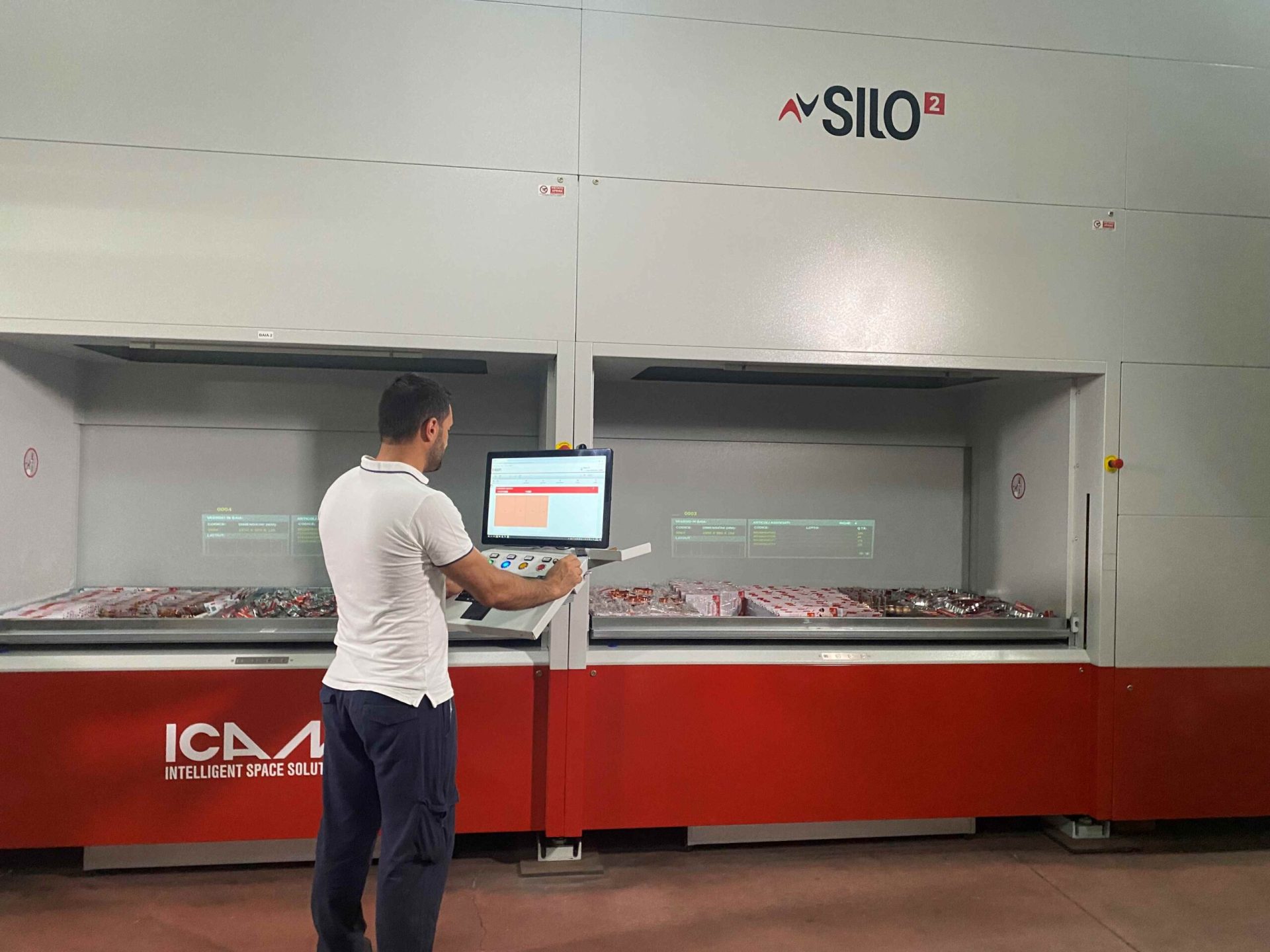
An elevator that moves between two rack columns brings trays containing parts to the access window. Since the trays are automatically positioned according to their height, wasted space is minimized. This is the most common solution for small and medium-sized parts, mold components, cutting tools, and electronic components. Example: ICAM SILO² vertical storage elevator.
Vertical carousel
The shelves rotate on a chain, bringing the desired shelf in front of the operator. This system is preferred in areas with limited ceiling height and for lightweight parts that are picked very frequently.
Mobile shelving system
Existing pallet or cantilever racks are mounted on bases that move along rails; only the aisle needed is opened. This is the most cost-effective way to increase capacity for heavy and bulky loads without purchasing new racks. Example: Compatta mobile racking system.
Automated Storage and Retrieval System (AS/RS)
A stacking crane moving along the aisle places and retrieves loads. It is used for long materials (profiles, pipes, bars), sheet metal, and pallets. Examples: Maxi STC for long materials, Maxi T for sheet metal and panels, and Maxi L for mixed loads.
Automated Material Delivery Locker (Smart Locker)
The system dispenses tools, consumables, and spare parts only to authorized users, with each transaction recorded. It eliminates stock losses and the “who has the part?” problem in tool rooms, maintenance shops, and shift-based production. Example: The Safe Box automated material dispensing system.
Advantages of a Smart Warehouse System
- Space savings: Because the ceiling height is utilized, the same inventory occupies up to 90 percent less floor space than with traditional shelving.
- Picking speed: The operator doesn’t have to walk around the warehouse, search for items, or climb ladders; the part arrives at the access window within seconds.
- Low error rate: Since the software retrieves the correct tray and, in most models, uses a light to indicate the correct eye, the risk of picking up the wrong part is virtually zero.
- Traceability: Every incoming and outgoing transaction is recorded with user, date, and quantity information; the inventory count is constantly updated.
- Safety: The components are housed inside a sealed enclosure; they are protected from dust, moisture, and unauthorized access.
- Ergonomics and workplace safety: Employees always work at the same waist-high window; heavy lifting and working at heights are eliminated.
For which businesses is it suitable?
Smart warehouse systems are not just an investment for large factories. A toolroom with a few hundred items can save both space and time with a small vertical storage lift. The most common applications in Turkey include: mold and toolrooms, the automotive supply industry, machinery manufacturing, metal processing (profiles, pipes, sheet metal), electronics, pharmaceuticals and medical supplies, maintenance and repair warehouses, and the defense and aerospace industries.
What should you look for when choosing a smart warehouse system?
- Cargo type and size: Is it a small part, a 7-meter-long profile, or a sheet of metal? There is a different system for each type of cargo.
- Ceiling height: Vertical systems benefit from height; capacity varies several-fold between 4-meter and 10-meter ceilings.
- Number of pick locations and picking frequency: How many items are picked per day? If picking is frequent, units with dual access windows or multiple units are planned.
- Software integration: The system must be able to communicate with the existing ERP or WMS; otherwise, inventory will be tracked separately in two places.
- Service and spare parts: The system will operate for many years; the service provided by the installation team should also be local.
- Scalability: One unit today, two units in two years. Modular systems allow you to add columns or units later on.
Frequently Asked Questions
Are "smart warehouse" and "automated warehouse" the same thing?
In everyday use, yes. “Automated storage system,” “vertical storage system,” and “smart warehouse system” all refer to the same product family. The general term used in technical literature is AS/RS (Automated Storage and Retrieval System).
Does the installation require a special floor or building?
Most vertical storage elevators are installed on standard industrial floors; only the floor load capacity and ceiling height are checked. For large systems with stacking cranes, a floor survey is conducted.
How long will it take for the investment to pay for itself?
This depends on the value of the space gained, the labor required for the move, and the cost of errors. During the planning phase, existing inventory and space are measured to calculate this figure specifically for the business.
Explore with Delta Smart Warehouse
Delta Smart Warehouse offers vertical storage lifts, mobile racks, AS/RS systems, and automated delivery systems from the Italian manufacturer ICAM in Turkey. Our team in Kocaeli will conduct an on-site assessment of your facility, measure your current inventory and space, and provide specific figures for the square meters you’ll gain and the reduction in picking time. Contact us for a site survey and quote.