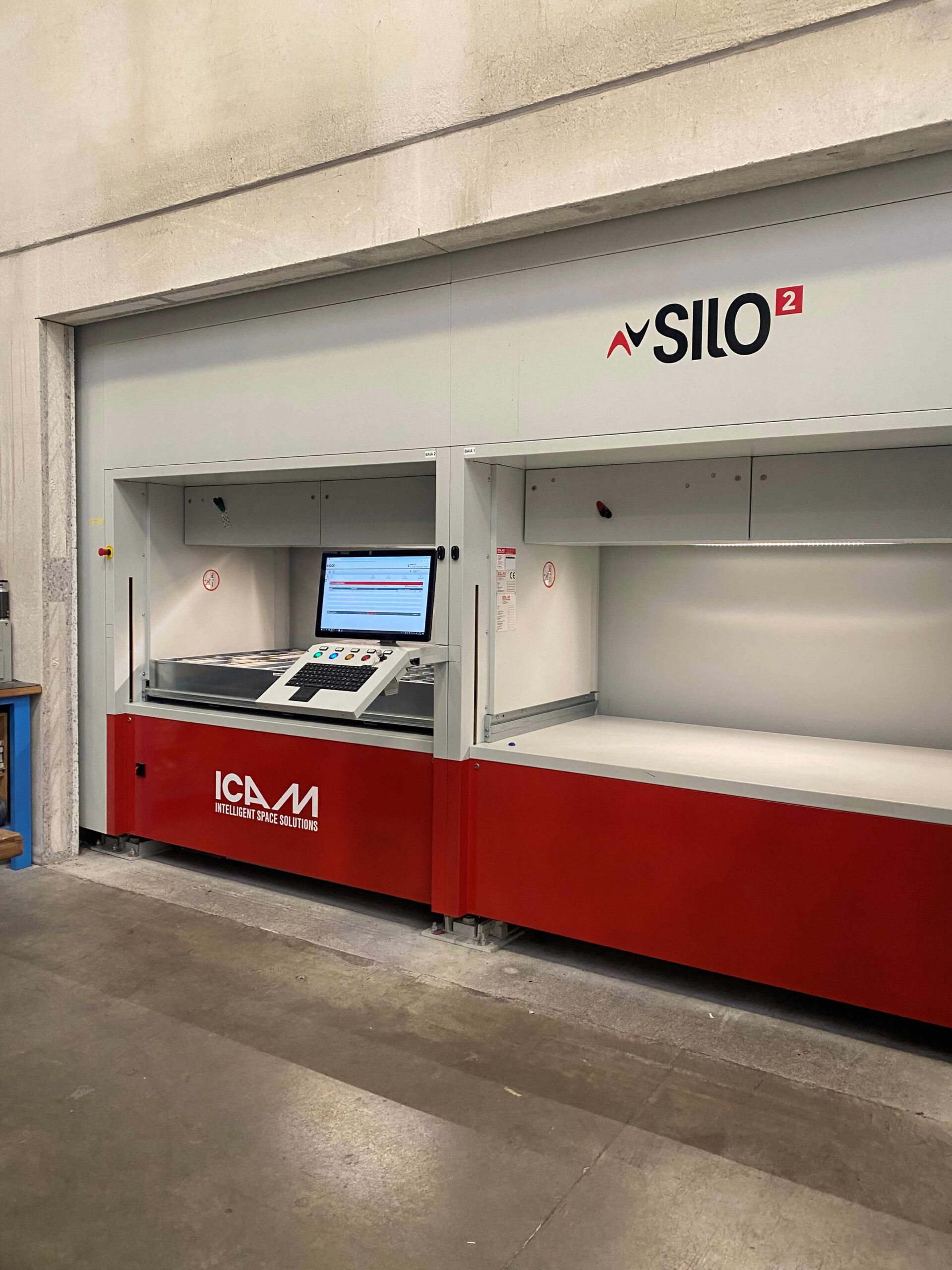
A vertical storage system is a closed storage unit that stacks parts toward the ceiling rather than spreading them out on the floor and automatically delivers the desired part to the operator. Its most common form is the vertical lift module (VLM). It can hold the same inventory in a fraction of the space occupied by a traditional rack and is the most widely installed member of the smart warehouse systems family.
How does a vertical storage system work?
Inside the unit, there are two tray columns—one at the front and one at the back—with a vertically moving elevator in the center. The operator enters the part code into the terminal or scans the barcode; the elevator retrieves the relevant tray from the column and brings it to the waist-high access window. After the part is retrieved, the tray is returned.
During the initial loading, the system scans the load height of each tray and arranges the trays in the column in the most compact manner possible. This eliminates the empty air volume above each compartment in a traditional rack; this is the primary source of storage density.
How much space does it save? Sample calculation
In a traditional shelving system, items are stored at a maximum height of 2–2.5 meters; the space above remains empty, and aisles are left between the shelves for forklifts or people to pass through. A vertical storage unit, on the other hand, can be used all the way to the ceiling (up to 15 meters for the ICAM SILO²) and does not require aisles.
Example: In a facility with 6-meter-high ceilings, the inventory stored in a shelving area covering approximately 100 m² of floor space can, in most applications, fit into one or two vertical storage units with a base area of 10–15 m². The space saved can be used for production, assembly, or a new machine. The exact ratio varies depending on part dimensions and ceiling height; under ideal conditions, floor space savings can reach 90 percent.
Advantages of a vertical storage system
- Space savings: The floor space required for the same inventory is significantly reduced; the existing building is used instead of a new warehouse.
- Quick picking: The part is brought to the operator; there is no walking, searching, or climbing stairs in the warehouse.
- Low error rate: The software selects the correct tray; on most models, the indicator light points to the correct eye.
- Inventory accuracy: Every transaction is recorded; there is no need to halt production for an inventory count.
- Safety: The enclosed housing components protect against dust, moisture, and unauthorized access.
- Ergonomics: The worker always works at a window at waist height; heavy lifting and working at heights are eliminated.
- Organization: The compartments in the tray provide a designated spot for each item; no more wondering, “Where did we put that?”
Points to Keep in Mind
- Investment cost: Higher than that of a traditional rack; the calculation should take into account the value of the space gained and the labor savings.
- Access point: One operator works at a time in a single-window unit; a double-window unit or an additional unit is planned for high-volume picking.
- Electricity and maintenance: The system is electrically powered; it requires annual periodic maintenance and local service.
- Load limits: There are maximum load limits per tray and per unit; for heavy, long, or sheet-like loads, different systems such as mobile racking or AS/RS are suitable.
For which parts is it suitable?
Ideal for a wide variety of small and medium-sized parts: mold components and standard parts, cutting tools, replacement parts, electronic components, fasteners such as bolts and nuts, pharmaceutical and medical supplies, samples, and archives. Specialized systems such as the Maxi STC for long materials (profiles, pipes) and the Maxi T for sheet metal and panels are preferred.
A vertical storage elevator or a vertical carousel?
In a carousel system, the shelves rotate on a chain; in an elevator system, the trays remain stationary while the elevator moves. The carousel system is advantageous in areas with low ceilings and for light, frequently retrieved parts. The elevator system makes better use of vertical space, places parts at different heights more efficiently, and handles heavier tray loads. The elevator system is the more common choice in industrial facilities.
Vertical Storage with ICAM SILO²
SILO² is ICAM’s tray-based vertical storage system: it can be configured with 2 to 7 columns, reaches heights of up to 15 meters, and supports loads of up to 400 kilograms per tray. Additional columns can be added later, and it integrates with ERP and WMS software. Delta Smart Warehouse handles the evaluation, installation, and service of SILO² in Turkey. Details: SILO² vertical storage elevator.
Frequently Asked Questions
Up to what height can a vertical storage system be installed?
It depends on the model; the ICAM SILO² can be configured for heights of up to 15 meters. As the ceiling height increases, the capacity increases for the same floor area.
Will it work with my current ERP software?
Yes. Vertical storage systems come with their own warehouse management software and integrate with common ERP and WMS systems; during the assessment, the integration plan is tailored to your existing software.
How long does the installation take?
Once the layout plan and floor inspection are complete, the installation of a unit typically takes a few days; the time required to load the trays varies depending on the variety of stock.
Space Calculation for Your Facility
The Delta Smart Warehouse team will conduct an on-site inspection of your facility, measure your existing shelving space and inventory structure, and provide a numerical estimate of the square meters you’ll gain with vertical storage. Contact us for a site survey and quote.